
Building the Physical Layer that Shifts Consumer Gadgets into Reimbursable Clinical Diagnostics
words by Ryan Neely without AI; all deficiencies are the author’s own
Summary
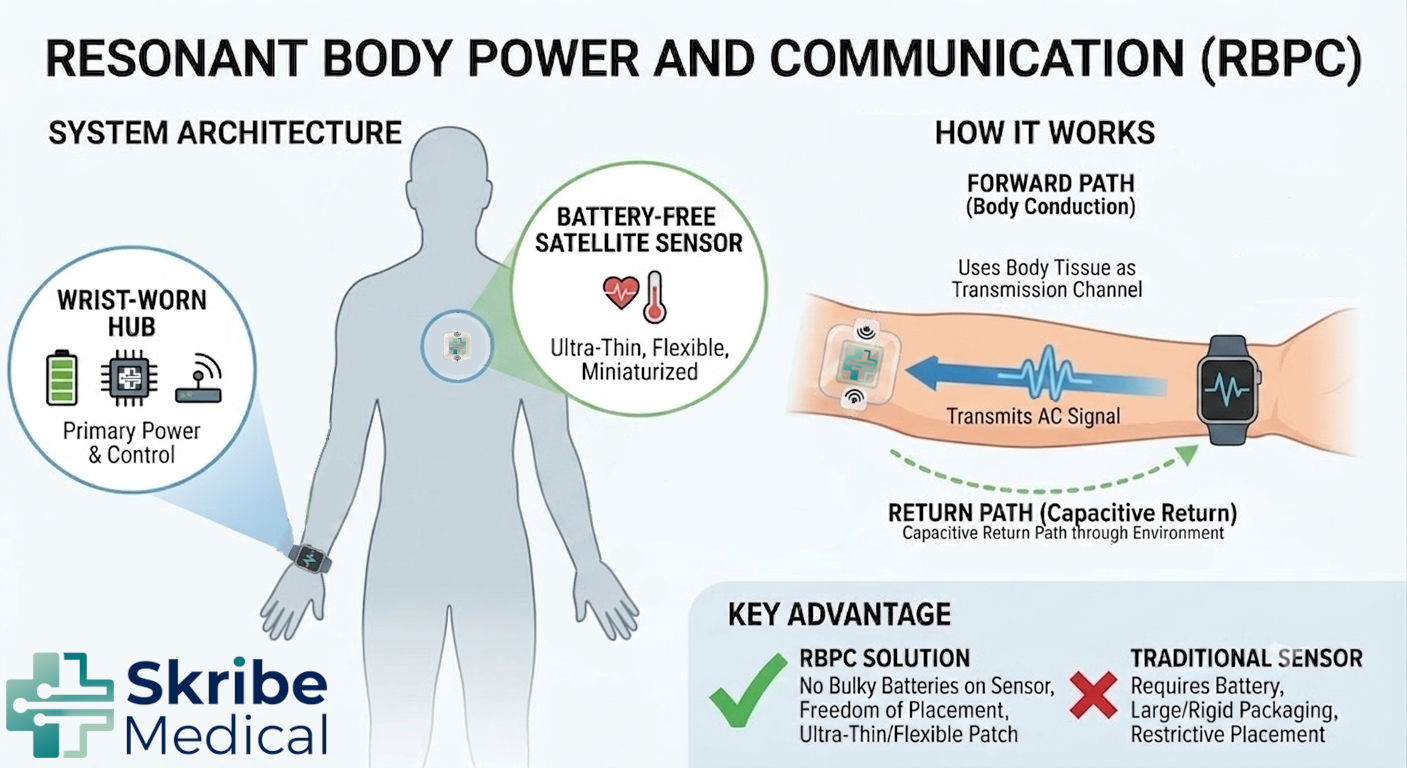
We envision a wearable intranet that leverages a technology we call Resonant Body Power and Communication (RBPC). This system creates a new physical network layer on the body, allowing energy and data to travel across the body surface from a central hub to one or more batteryless satellite sensors. This approach eliminates bulk and logistical constraints that currently bottleneck full-body wearable sensing and enables the collection of data that meets thresholds for clinical relevance. In parallel with innovation and miniaturization of novel sensors, this new network layer can expand and improve the diagnostic relevance of wearable devices by allowing sensors to be placed directly over target organs on the body while minimizing discomfort. Rather than designing each sensor as a standalone device complete with its own power source and communication hardware, RBPC creates a shared power and data network on the body, maximizing the utility and reach of next-generation wearables to move healthcare towards a personalized, preventive model.
One Ring (or Band or Watch) Does Not Rule Them All
Consumer HealthTech giants are platforms built around single devices. The capabilities of these devices continue to expand (and become increasingly homogeneous) – and yet, the rate of adoption into physician workflows is 6% or less1. This bottleneck is caused by two primary and related limitations2:
- Many wearables measure signals are distant from and only serve as proxies for organ systems that they intend to monitor (ex: pulse rate and wrist motion as a proxy for brain state during multi-stage sleep scoring)
- These proxy measurements don’t fit existing diagnostic criteria that physicians use to make decisions and treat disease (ex: sustained muscle activity during REM sleep as measured by EMG is required for a diagnosis of REM Sleep Behavioral Disorder)
However, wearable devices can overcome these barriers. Arrhythmia monitors like iRhythm’s Zio and continuous glucose monitors (CGMs) from Dexcom are prime examples, which have both gained substantial clinical traction and payer reimbursement. What makes these devices unique is not clearance from the FDA or large-scale clinical validation – several other wearables can claim these as well. Arguably, these devices succeed in providing clinical value through how they collect and deliver information.
Location, location, location
Arrhythmia monitors are looking for abnormalities in the heart’s electrical activity, and it’s not a coincidence that they are placed directly above the heart. Is it possible to detect these signals from the wrist? Yes – and there is data to support the feasibility of this approach. But for wearable devices that must be operated by non-technical users in real-world environments, shifting from a set of electrodes adhered to the chest to a band worn around the wrist introduces room for error, variability, and uncertainty. This type of reading might get the patient into the clinic, but it’s only a gateway to the real, definitive test. Similarly, a CGM is adhered to the upper arm not for convenience, but because it’s a rich source of interstitial fluid and less likely to invite interference compared to other body locations.
Less is more
Wearables can collect millions of longitudinal data points from multiple sensors, creating a rich source of information about a single individual. In the clinic, this is a bug – not a feature. Practically, physicians don’t have time to parse through this pile of data. But even in an inevitable future where AI handles this task, it’s not clear that these signals map to clinically defensible, actionable insights. Treatment decisions are made (and reimbursed) based on a defined set of diagnostic criteria, and a downward trend in “recovery score” coupled to a change in heart rate variability isn’t enough to trigger a diagnosis. Right or wrong, diagnostic tools used to make these decisions must generate specific metrics (like the presence of atrial fibrillation or glucose < 54mg/dL) in a way that is straightforward and easily fits clinical guidelines.
Making Wearables Matter Without Creating Cyborg People: the Wearable Intranet
Building wearables that move the clinical needle requires placing sensors where they can collect reliable, high-quality data, and distilling that data into metrics that fit simple diagnostic criteria. With the right signals, the second requirement can be satisfied using modern analytical tools. The first requirement, however, is much more challenging to scale.
The problem with distributed sensing
The miniaturization of sensors for infrared, ultrasound, and other modalities is increasingly making it possible to peer into the body using devices that are small enough to be worn. Imaging technology that previously was wheeled around the clinic on a cart now fits into a case the size of a cell phone or smaller. This creates the potential to truly replicate the types of measurements relied upon by physicians with devices used at home. Today’s wearables have achieved high consumer adoption by mimicking tried-and-true wearable objects: watches, bracelets, and rings; sensing as many metrics as possible from these constrained locations. Leveraging the next generation of sensor technology, however, will require moving beyond these familiar designs and imagining new devices that can capture signals from places on the body without existing predicates. This creates significant barriers for adoption and scale: wearing a watch on the wrist is much more palatable than placing watch-sized devices on the torso or head. Although bulky devices in some places on the body might be tolerated in lieu of an office visit, they will fall short of predictive, longitudinal monitoring without a significant reduction in size, weight, and stiffness.
Turning the body into a LAN, or an external, wearable nervous system
Consider how your body senses itself and the environment. Nerve endings terminate at precise locations – a fingertip to sense pressure or temperature, the nostril to catch incoming chemical signals in the air. But the cell bodies to power these nerve endings and neural circuits to analyze their signals are centrally located – we don’t have a little brain at the end of every finger.
What if wearable sensor networks could act the same way? Instead of co-locating each sensor with its own battery, communication system, and computation circuitry, what if data and energy could be passed to and from a central location – for example, a smartwatch – to several sticker-like sensors placed wherever was necessary?
At Skribe, we are building on decades of research into Body-Area Networks to create something we call Resonant Body Power and Communication (RBPC). By leveraging the natural conductivity of the skin (and some sophisticated electronics), we can transmit energy and data across the body surface from a hub device (such as a smartwatch) to battery-free, antenna-free sensor satellites anywhere on the body. The benefits are clear: as we develop new sensors, we can leverage flexible electronics and lightweight adhesives to construct them like small band-aids, making them easy and comfortable to place securely where physiological signals are strongest. The bulk of the system – the “brain” and power source – can be built into the same smartwatch form factor that already has widespread adoption. Finally, several satellite nodes can draw energy from and communicate with a single hub, allowing the system to scale without adding additional logistical complexity (for example, the need to charge multiple devices).
Our Path Ahead
From a technology perspective, this next-generation body sensor network relies on miniaturized, low-profile sensors and the RBPC-based network layer to connect them. We’ve already built biophysical models and working prototypes to demonstrate that Resonant Body Power and Communication is possible and meaningfully more efficient than other forms of wireless energy transfer across or through the body. In parallel, we’ve also developed new low-profile sensor designs that maximize the clinical utility of the signals they measure. But any new technology needs to solve more than one problem in healthcare to succeed: it has to improve patient care, enhance physician performance, lower insurance costs, and appease regulators. For that reason, we’re not waiting to start tackling these challenges as we develop RBPC into a mature commercial product.
We’ve identified a high unmet need in the crucial field of cardio-oncology, where we know that our novel sensor technology and AI models can make a meaningful impact today on protecting the heart health of cancer patients while eliminating delays in life-saving treatment. We’re taking the fastest path to bring these sensors to market while developing RBP in parallel, ensuring that it will have an established regulatory precedent, clinical indication, and commercial framework to directly plug into. We’re close to wrapping up our 500-patient NOECHO study with our clinical prototype, and meanwhile we’ve been iterating on the device design to make it ready for the final steps of clinical development.
Building in healthcare is complicated and often bewildering, but there are so many opportunities to improve how we deliver care – we’re grateful to be able to contribute.
- American Medical Association and Medscape, International Physician Survey on Consumer Wearables (American Medical Association, 2024), ama-assn.org.
- Serrano, L.P., Maita, K.C., Avila, F.R., Torres-Guzman, R.A., Garcia, J.P., Eldaly, A.S., Haider, C.R., Felton, C.L., Paulson, M.R., Maniaci, M.J. and Forte, A.J., 2023. Benefits and challenges of remote patient monitoring as perceived by health care practitioners: a systematic review. The Permanente Journal, 27(4), p.100.